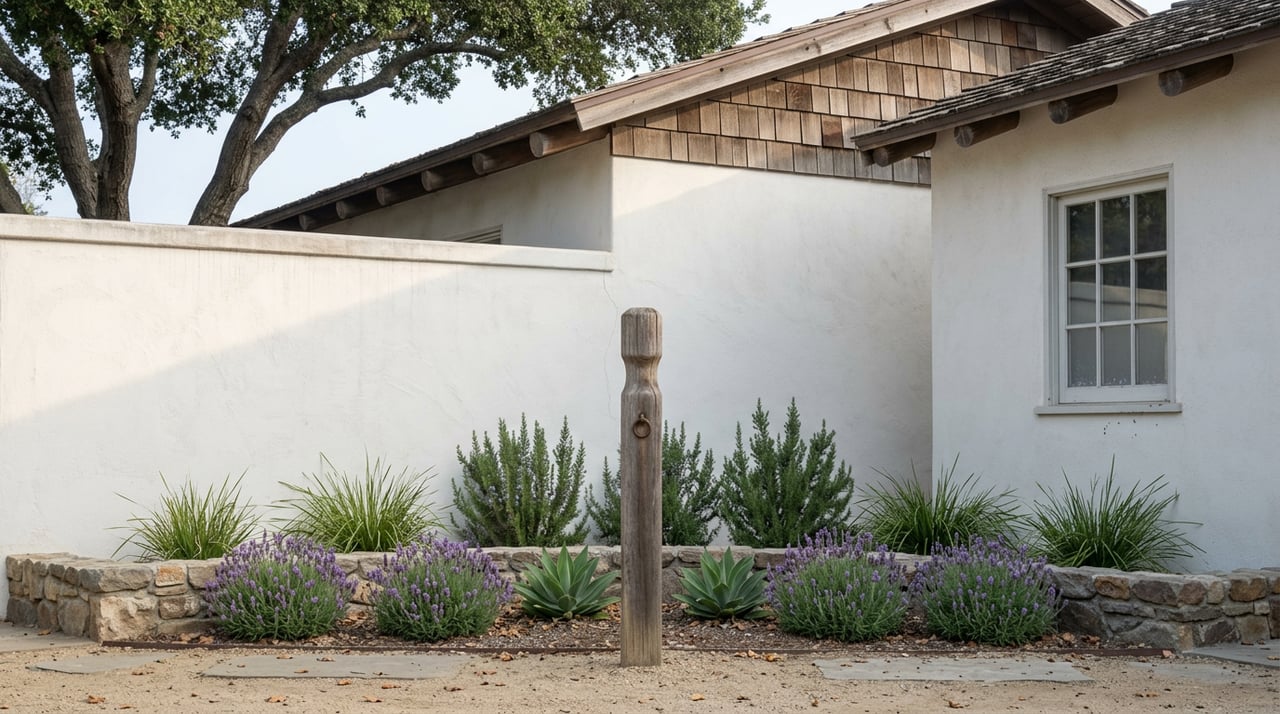
Drive along Palos Verdes Drive North and the split-rail fences look the same on both sides of the city line. No streetlights, wide verges, horses grazing behind low wood rails, that same three-square-mile hush that gives the Peninsula its reputation. Rolling Hills and Rolling Hills Estates share a name, a border, and a devotion to the horse. What they do not share is who controls the ground under those trails, and that difference decides who is allowed to use them.
In Rolling Hills Estates, the city itself maintains more than 20 miles of bridle trails as a public recreational asset, open to residents the way a park is open. In Rolling Hills, one gate over, the trail system runs on a completely different premise. The Rolling Hills Community Association puts the network at nearly 30 miles, and every foot of it sits on private easement. There is no public property inside the city limits at all, a fact the city's own visitor page states outright. If you own a home here, you do not automatically have the right to walk the loop behind your own fence line. You have to be let onto it.
Two Governments, One Gate
The confusion starts with a detail most residents absorb slowly rather than all at once: Rolling Hills is run by two separate organizations that predate and outlast each other in different ways. The RHCA was founded in 1936 by developer A.E. Hanson and the Palos Verdes Corporation, twenty-one years before the city of Rolling Hills incorporated on January 24, 1957. The association came first. The city came later, layered on top to provide public safety and permitting under contract with Los Angeles County, while the RHCA kept control of the roads, the gates, and the trails it had already built.
That split still holds today, and it explains why a call about a downed trail marker goes to a different office than a call about a grading permit.
| Handles | City of Rolling Hills | RHCA |
|---|---|---|
| Public safety, animal control, trash | Yes | No |
| Building and grading permits | Yes | Reviews plans, issues permits |
| Roads, gates, easements | No | Yes |
| Bridle trails and riding rings | No | Yes |
| Architectural review | No | Yes |
Both entities confirm this division in their own public materials, and it is worth knowing before you need either one.
The Badge That Decides Who Rides
Here is the part that catches people off guard, including people who have lived here for years. Riding the trails requires an RHCA-issued trail badge. Walking them without a horse requires being a resident, or being on a resident's guest list and accompanied by one. Bicycles and motor vehicles are barred outright, and every rider entering the community has to check in with the gate attendant on the way in.
Getting a badge is a paper process, and an oddly personal one. You bring a completed application and a passport-sized photo to the RHCA office at 1 Portuguese Bend Road, or you email both to the association directly. If you are renewing, you can often reuse the photo from your expired badge. The office keeps hours that feel more like a small-town clerk's than a modern HOA: Monday through Thursday 7:30 a.m. to 4:45 p.m., Friday 7:30 a.m. to noon.
What the badge does not cover is just as telling. It is issued to equestrians only. A visiting adult child, a weekend houseguest, a friend staying over while their own home is being renovated: none of them can walk the trail behind your property alone, no matter how long you have lived there or how well they know the neighborhood. They need to be named on a list you provide and accompanied by you. The trail looks like a shared amenity from the street, but access is governed by those requirements.
Built by Neighbors Before the City Existed
The reason the system runs this way traces back further than most people expect. In 1951, six years before Rolling Hills was even a city, a group of residents who shared an interest in horses formed a club and took on the job of physically building the bridle trail network themselves. The club's first president was Jesse Powers. Its first trails chairman was Roland Swaffield. What Caballeros built by hand in the early 1950s is substantially the same network the RHCA maintains and Caballeros still monitors today, three-quarters of a century later.
That history provides context for the trail network's origins. The badge, check-in requirement and accompanied-guest rule describe how access works today. Caballeros continues to monitor the network, while the RHCA issues trail badges. Caballeros' board still meets monthly, at 7 p.m. on the third Wednesday, a detail that tells you this is an active club with a working calendar rather than a name on a letterhead.
Tennis Followed the Same Script
The trail system is not the only piece of Rolling Hills life that runs on club membership rather than city recreation department scheduling. The Rolling Hills Tennis Club started in May 1961 as a committee formed to set rules for the community's single tennis court. It became a formal club in 1973 and had 175 members within two years. For decades it served a defined membership rather than every household in the city. That changed in 2014, when the club opened to all Rolling Hills residents and renamed itself the Rolling Hills Tennis and Social Club, expanding its calendar to club tournaments, monthly socials, an annual exhibition match, a holiday party, and an annual weekend getaway.
The pattern is consistent across both the riding trails and the tennis courts. Neither amenity was handed to residents by a developer's brochure and left to run itself. The trails were built through resident effort and are monitored by Caballeros, while the RHCA maintains the network and issues trail badges; tennis still offers resident participation through the Tennis and Social Club. Both require active participation rather than passive entitlement by address.
What This Actually Means Day to Day
If you live in Rolling Hills, the practical takeaway is not a warning. It is closer to a map. The trails and the tennis courts are not backdrop scenery that comes with the property line. The trail network was built by Caballeros, which still monitors it, while the RHCA maintains it and issues trail badges. Getting the full use out of the trails and tennis courts means engaging with Caballeros or the Tennis and Social Club directly rather than assuming access follows automatically from your address. The RHCA also maintains formal View Protection Guidelines and other governing documents that shape day-to-day decisions here, another layer worth knowing exists even if it rarely comes up outside a renovation or a tree dispute.
None of this makes Rolling Hills harder to live in. It makes the community more precisely what it has always claimed to be: not a subdivision dressed up with split-rail fences, but a working private ranch community whose trails were built by residents, are monitored by Caballeros and maintained by the RHCA, and require RHCA-issued badges for riding, while tennis and social life involve resident participation. Knowing that changes how you use the place. It also changes who you call when something needs fixing.
If you are weighing a move within the Peninsula, or you already live behind one of these three gates and want a clearer read on how the pieces fit together, Jane Angel has spent two decades working this stretch of the South Bay and can walk you through it directly. Book an Appointment to talk through what any of this means for your specific address.
This article is general information, not legal, tax or financial advice. Consult a qualified professional about your situation.