On a Saturday morning, the parking lot at Ladera Linda Community Park in Rancho Palos Verdes fills up in a predictable order. The pickleball and paddle tennis courts go first, then the soccer fields, then the basketball court, then whatever patch of grass is left for a dog and a frisbee. Families haul folding chairs toward the playground. A handful of disc golfers wander the perimeter looking for a basket that isn't in use. Almost everyone who parks here came for one of those things, and almost none of them walk the single track that starts a few hundred feet past the athletic fields and climbs into the hillside behind the park.
That trail is the Ladera Linda Quarry Trail, a 1.2 mile loop with about 318 feet of elevation gain that takes most people 30 to 45 minutes to finish. It winds around the rim of a former stone quarry that exposes rock formed roughly 14 to 16 million years ago on an ocean floor that, because of movement along the San Andreas Fault, was actually sitting off the coast of Baja California at the time. The park most residents know for its rebuilt community center and its courts sits directly at the trailhead for one of the more unusual short hikes on the Peninsula, and most of the people who use the park have never taken it.
The Park Everyone Already Knows
Ladera Linda has been an actively staffed park since 1982, when the city converted a former elementary school site into public recreation space. The community center building most visitors see today is newer, a modern structure with a multipurpose room that can hold around 60 people, floor-to-ceiling glass doors that open onto ocean views, and a layout built for both drop-in rec use and private event rentals. Outside, the amenities read like a small city recreation department's greatest hits: basketball court, paddle tennis courts, soccer fields, a playground, and enough open lawn for informal disc golf.
None of that is a secret. It's the reason the lot fills up. What's less obvious, unless someone has told you, is that the trailhead for the Quarry Trail begins right near those athletic fields, and it leads somewhere the courts and fields don't hint at at all.
What the Trail Actually Circles
The quarry itself has a name most residents have never heard: Livingston Quarry. It sits inside the Forrestal Nature Preserve, a reserve the Palos Verdes Peninsula Land Conservancy has managed since 2001, coordinating trail work and habitat restoration alongside community volunteers. The eastern portion of the reserve contains the old quarry bowl, and the marked trail winds around the top of it rather than down into it.
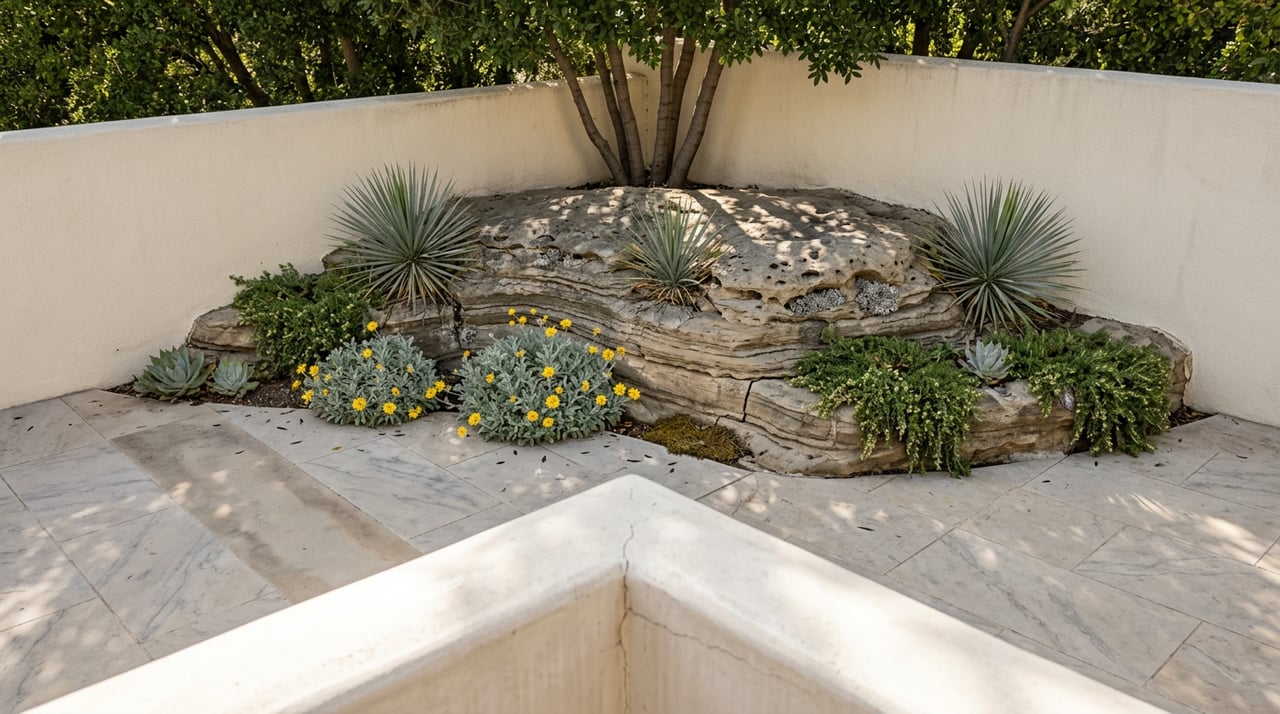
What makes the site worth the walk is what's exposed in the rock face. The cliffs here show folded and faulted sedimentary beds from the Altamira Shale Member of the Monterey Formation, laid down in deep Miocene-era seas roughly 14 to 16 million years ago. As those beds were forming, volcanic basalt pushed up into them from below, in some places breaking through to the seafloor entirely. You can still see the basalt intrusions in the quarry walls today, along with fossils embedded directly in the rock, including old fish scales. The Conservancy asks hikers not to collect anything or disturb the slopes, since the formations are part of what the reserve exists to protect. If you want to hold a piece of this rock rather than just look at it, there's a sample display at the Point Vicente Interpretive Center a few minutes down Palos Verdes Drive West.
That interpretive center connection isn't incidental. The same Altamira Shale that shows up in the Livingston Quarry walls was commercially quarried elsewhere on the Peninsula under the name Palos Verdes Stone, prized for its color and used in local decorative walls, patios, and building facades. The exterior of the Point Vicente Interpretive Center itself is finished in it. Walk the Quarry Trail in the morning, then drive over to look at the lighthouse and the interpretive center's walls in the afternoon, and you're looking at the same geologic material twice, once in its raw folded state and once cut and set into a public building.
A Short Walk With a Few Real Conditions
The trail is short, but it isn't flat, and it isn't shaded. The path includes a steep incline early on, a flatter stretch along the Mariposa Trail, and a gradual descent back down the Quarry Trail portion, with loose dirt and rock in places. Dogs are welcome on leash. Spring brings wildflowers along the hillside, and the lack of tree cover means sun protection and water matter more than they would on a shorter neighborhood stroll.
One practical note worth knowing before you go: Forrestal Drive is sometimes closed near the community center itself, which means the trailhead most people expect to drive to isn't always reachable by car until later in the day. When that happens, you park at the community center and walk the last half mile in. The city keeps a running list of trail closures and access notes for the Peninsula's preserve system on its trail conditions page, which is worth a quick check before a weekend outing, especially after rain when parts of the coastal trail network see more frequent closures.
The Organization Keeping the Rock Face Standing
The Conservancy that manages this small quarry loop is the same one responsible for a much larger and, frankly, more improbable project on the Peninsula: helping bring back the Palos Verdes blue butterfly, widely considered the rarest butterfly in the world. The subspecies was thought to be extinct after its last confirmed sighting in 1983, until it was rediscovered in 1994 on a small patch of native habitat in San Pedro. Since then, the Conservancy and its partners have run annual reintroduction efforts and habitat restoration work across the Peninsula's protected lands, using tools as unglamorous as herds of grazing goats, sometimes numbering in the hundreds, to clear invasive plants like fennel and ice plant and let native coastal sage scrub return.
That work spans the same 1,400 acre Palos Verdes Nature Preserve system that includes Forrestal, and it's been going on across four cities, Rancho Palos Verdes, Rolling Hills, Rolling Hills Estates, and San Pedro, since the Conservancy's founding in 1988. The Quarry Trail is a small, quiet piece of that larger effort. Most people walking it on a Saturday afternoon aren't thinking about butterfly recovery plans or goat grazing contracts. They're just noticing that the trail feels a little wilder and a little less manicured than the park they parked next to, and there's a reason for that: it's managed as habitat first, recreation second.
Two Parks in One Parking Lot
The habit worth building isn't complicated. Ladera Linda works fine as a place to play a set of pickleball or let a dog run on the soccer field grass, and most visits will keep looking like that. But the next time a Saturday morning trip to the courts wraps up early, or a weekend guest wants to see something besides another coastal overlook, the quarry loop is sitting right there, unphotographed and mostly unused, a few hundred feet past the last soccer goal. It's short enough to fit before lunch, specific enough to have an actual name and a real geologic story behind it, and close enough that it never requires planning a separate trip.
That's the version of Rancho Palos Verdes that doesn't show up in the drone footage of Terranea's bluffs or the postcard shots of Wayfarers Chapel's old site. It's the version where the park you already use for something else turns out to have a second thing worth doing, and almost nobody bothers to find out.
If you're weighing a move to a neighborhood where the parks reward this kind of curiosity, Jane Angel has spent two decades learning which corners of the Palos Verdes Peninsula reward a second look. Book an appointment to talk through what life actually looks like in Rancho Palos Verdes, beyond the listing photos.