On an evening this past July, Spectrum News found Alisa Schulman-Janiger on the bluff at Rancho Palos Verdes, still watching the water a month and a half after her count had ended for the year. She told the reporter, "I've been running this gray whale census project since 1984. So, this is our 42nd season." She also gave the season's high mark: "When you think of the good old days, I could see 80, 90, 100 gray whales a day. 152 was our highest on one day. I think this year we had 30 on one day."
Her counters go back out on Tuesday, December 1, on the patio of the Point Vicente Interpretive Center. Their count tracks how many gray whales take the lane that runs close to the Peninsula's cliffs. That lane can stay quiet even in a year when the population looks larger, and the count's clearest signals come from calves and from the spring half of the season.
A Patio Station on a Cliff That Drops Off Fast
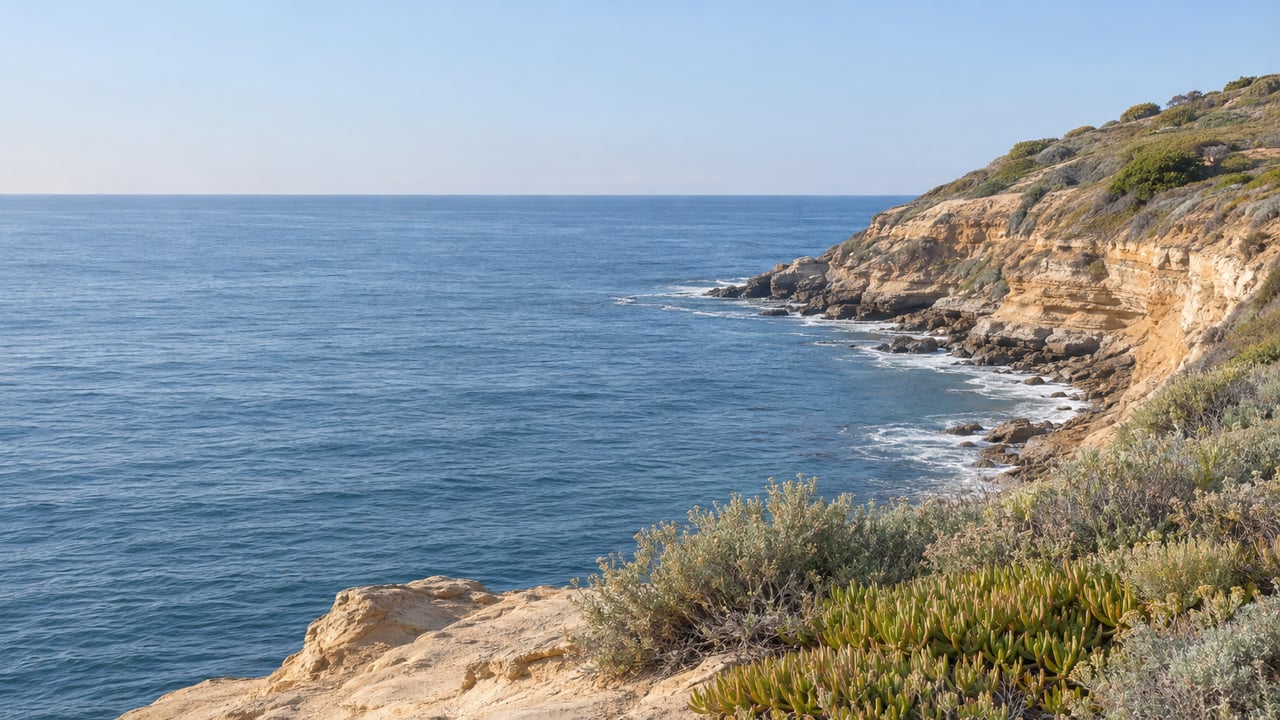
The American Cetacean Society's Los Angeles chapter has run the Gray Whale Census & Behavior Project every year since 1979, except for 1981-82 and 1982-83. It moved between Long Point and Point Vicente before the Point Vicente Interpretive Center patio became its main station in the 1985-86 season. The patio sits 125 feet above the water, and the bottom drops off steeply close to shore there, which brings passing whales within binocular range. Trained volunteers from ACS/LA and the Cabrillo Whalewatch Program staff the station, joined by members of the public.
Spotters work during daylight hours, seven days a week, from December 1 through late May. They use Fujinon 7x50 binoculars with built-in reticles and compasses, confirm sightings through spotting scopes, and log weather and sea conditions at least once an hour. They also record behavior, including breaching, spyhopping, courtship and apparent nursing, along with boat interactions and entanglements. Gray whales get the most attention, but spotters log any other marine mammal that passes, from common and Risso's dolphins to humpback, blue and fin whales, sea lions and elephant seals.
ACS/LA states the station's main limitation on its own count page. Most gray whales in this stretch of the coast travel offshore, mainly through the Channel Islands, and the southbound migration leans offshore even more heavily. The patio therefore sees only a small share of the population. ACS/LA says its counts "cannot be used to determine that population" and that the project instead tracks seasonal use of the nearshore path and how that use changes over time.
Why the Patio and NOAA Told Different Stories Last Winter
The two counts that matter most to the Peninsula moved in different directions over the last few seasons.
At Point Vicente, the totals fell. ACS/LA counted 292 southbound and 755 northbound gray whales in the 2022-23 season and called the southbound figure a record low. The 2023-24 season came in at 225 southbound and 579 northbound. The 2024-25 season, which ran from December 1, 2024 to May 25, 2025, set new record lows of 130 southbound and 485 northbound. In the 2025-26 season, sightings improved slightly but stayed very low, according to Schulman-Janiger's Spectrum News interview. Her best day was 30 whales, against a single-day record of 152.
NOAA Fisheries counts the southbound migration from a station on the central California coast, and its season went differently. From January 5 to February 13, 2026, 15 trained observers logged 302.2 hours over 39 survey days and counted an estimated 2,563 whales. Their best day was 158 whales on January 19, 2026. From those counts, NOAA's July 2026 abundance report estimated 17,750 eastern North Pacific gray whales for the 2025-26 southbound migration and called the figure "an encouraging finding" after the drop between 2023-24 and 2024-25.
According to NOAA, the jump is larger than births could produce, and it came during years when calf production stayed low. NOAA says factors other than births and deaths must be affecting the estimate, such as sampling error, changes in how easily whales are detected, or "potential changes in gray whale migratory behavior."
A best day of 158 whales on the central coast and a best day of 30 off Point Vicente in the same winter are consistent with ACS/LA's own warning. Shifts in migration routes and weather can swing the patio's count sharply without the population changing to match. The patio measures how many whales choose the inside lane past the Peninsula. Over the past several winters, fewer of them did.
The Calf Count Is the Patio's Clearest Signal
The patio may not be able to measure the population, but it does track calves well. ACS/LA records calf sightings in detail in both directions, and the project uses them to follow trends in how many young whales join the population.
The calf numbers have fallen even more steeply than the totals. Spotters at Point Vicente saw 22 southbound calves and 34 northbound calves in 2023-24. In 2024-25 they saw no southbound calves and 8 northbound calves. NOAA's calf-production estimate for 2025 was 85 calves, the lowest in its series. In the Baja calving grounds, researchers at Laguna San Ignacio photo-identified 8 mother-and-calf pairs in winter 2026, which tied the lagoon's low set in 2025. They also found that the whales left the lagoon about two weeks earlier than in previous winters, possibly because of warmer-than-average water.
These numbers are why a calf sighting from the patio gets recorded in such detail. Each mother and calf seen heading north past Point Vicente adds to one of the few long-running local records of whether young whales are making it.
Spring Is the Busier Half of the Season
The patio's numbers point to one practical pattern for anyone planning a visit. In every season above, the northbound total was well over double the southbound total: 755 to 292 in 2022-23, 579 to 225 in 2023-24, and 485 to 130 in 2024-25. Southbound whales are the ones most likely to stay offshore. That is why the first weeks of the count, when the counters return, are often the slowest stretch to watch from shore. The northbound months bring more traffic past the cliff, and that is also when mothers with calves pass the patio.
December is still worth a visit. The counters log every marine mammal that passes, and a slow gray whale morning can still turn up dolphins or a humpback. Schulman-Janiger also mentioned another factor for this winter. In July she said a forecast El Niño could warm California waters and make food harder to find, which might push whales to range more widely for alternatives.
Planning a Morning at Point Vicente
The Point Vicente Interpretive Center is at 31501 Palos Verdes Drive West. The City of Rancho Palos Verdes lists the museum and gift shop as open daily from 10 a.m. to 5 p.m., and the grounds from dawn to dusk. The counters work during daylight, so an early walk on the grounds before the museum opens can line up with the start of their watch. Details are on the city's facility page.
ACS/LA posts the latest gray whale tally and its recent sightings on its Today's Whale Count page. Checking that page before heading out shows whether the week has been busy or quiet. Neighbors who want to join the spotters can find the volunteer contact for the census director on the chapter's Gray Whale Census page.
Later in the season, the City and the Los Serenos de Point Vicente docents host Whale of a Day, the annual spring festival at the center. It takes place during the northbound migration, the busier half of the count. To spend more time along this part of the coast, the city's trail network beyond the Preserve is covered in our guide to the Rancho Palos Verdes trails that stay open when the Preserve closes.
I have spent more than two decades helping families buy and sell along this coast, and I know how much the view from a Rancho Palos Verdes home matters, including the stretch of water where the whales pass each winter and spring. If you would like to talk about which parts of the Peninsula face that lane, or what an ocean-facing home is worth in today's market, Jane Angel would be glad to meet. Book an appointment, and we can start with your view.